
Słuchaj tego podcastu za darmo w aplikacji: Pobierz za darmo z App Store
radio.pl
Sleep timer
Zapisz stacje
66 odcinków
Every Artist Is an Entrepreneur — Whether They Like It or Not
08.07.2026 | 9 min.Your art is a business. The sooner you accept that, the sooner your career actually starts. In this episode, Jake breaks down the philosophy that's guided everything he's built — every artist is an entrepreneur, and the ones who don't treat it that way usually don't make it.
There's a hard line between a hobby and a career, and most artists don't want to look at it too closely. Jake does — and in this episode of Move Faster, he makes the case as directly as he can: if you want to get paid for your art, you are running a business, and it's time to start acting like it.
That doesn't mean you have to become a spreadsheet person. It means understanding that your craft is the product, your audience is the market, and everything from your website to your invoicing to your social media is the infrastructure of a company — yours. Lady Gaga and the person doing karaoke on weekends both love music. The difference is one of them built a business around it.
Jake walks through what that actually looks like in practice: the Starbucks and McDonald's analogy for understanding what need your art fulfills, why good enough for your audience beats objectively perfect every time, and how Curry Barker made a film for $800, submitted it to festivals, and eventually produced a $200M box office hit. He also shares his favorite low-key life hack — the fake assistant email — for anyone who's ever needed a buffer between themselves and a negotiation.
The goal isn't to do all of it at once. It's to take one business step this week, then another, until it becomes a full operation.
In this episode:
Why "I just want to make art" without the business side means you have a hobby, not a career
The Starbucks/McDonald's framework for understanding your artistic market position
What Curry Barker's career teaches about craft, marketing, and festival strategy
The fake assistant email trick — and why David Hasselhoff was ahead of his time
The one business question every artist should ask themselves this weekYou Have to Be Willing to Suck As An Artist
01.07.2026 | 6 min.Nobody starts out good. The artists who make it aren't the most talented — they're the ones who were willing to make a lot of bad work to get to the good stuff. In this episode, Jake makes the case for why being willing to suck is the most underrated skill in any creative's toolkit.
It's not a fun lesson, but it might be the most important one: most artists struggle because they're simply not good enough yet. And the only way through that is to make a lot of work that isn't good.
In this episode of Move Faster, Jake gets honest about what he's seen after years of casting actors and running a creative agency — and what he's experienced himself losing jobs he wasn't ready for. The gap between where you are and where you want to be isn't closed by waiting. It's closed by reps.
He brings in three artists who prove the point. Ed Sheeran's "dirty tap" analogy — at first the water runs brown, but you keep it running until it clears. The A-Team took 20 minutes to write, but only after hundreds of songs that didn't work. Russ put out seven albums with no traction, then released a song a week for two and a half years before things broke. And Kobe Bryant ran three practices a day with the simple logic that if his competitors were doing two, he'd eventually be unreachable.
The formula is unglamorous: make more art, get better faster, and let people call you an overnight success when you've actually been grinding for a decade.
In this episode:
Why most artists aren't making it — and what's actually in the way
Ed Sheeran's dirty tap analogy and what it means for your creative output
How Russ went from seven ignored albums to breaking through with a song a week
Kobe, Phelps, and the math of doing more reps than everyone else
Whether you need to post your work publicly — or if you should just put your head down for five yearsGet Paid to Practice: The Balance Between Art and Commerce
10.06.2026 | 8 min.Every artist faces the same tension: doing the work that pays the bills vs. doing the work that feeds the soul. In this episode, Jake makes the case that the line between them doesn't have to be a war — and that the smartest artists find a way to get paid to practice.
There's a version of this story most artists know too well: working a job that has nothing to do with their craft, saving up, burning out, and wondering if the dream is even possible. Jake has a different model — and in this episode of Move Faster, he breaks it down.
The concept is simple: get paid to practice. Find work close enough to your craft that every day on the job is also a day of reps. Jake runs a video production agency that funds his real passion — narrative filmmaking. That agency paid for the gear, the skills, and the bandwidth that let him make 14 short films in four months with his wife. It's not a compromise. It's a strategy.
He runs through three real examples: a musician who does audio engineering by day and uses the income to self-fund his own releases and Spotify advertising; a photographer who shoots weddings to bankroll his landscape photography and print sales; and an actor friend spending a small fortune on a short film he could have made scrappier — because he never built the infrastructure that comes from working in the field. Then there's Kurtis Brewer, who kept grinding on his horror projects on the side until one of them grossed over $200 million.
The point isn't to stay in the day job forever. The point is to use it until the art pays for itself — and to not waste the off-hours on another Netflix binge when that time could be closing the gap.
In this episode:
The "get paid to practice" principle Jake learned from a mentor early in his career
How Jake made 14 short films in 4 months — and what made it possible
Three real artist archetypes funding their craft intelligently
Why the side hustle is temporary — and what you're actually building toward
The honest question every artist needs to ask about how they spend their off-hoursWhat Is The Life You Actually Want? The Question Every Artist Avoids
03.06.2026 | 7 min.Most artists plan their career first and figure out their life later. Jake flips it — and makes the case that the life you want should come first, and everything else gets built around that.
Before you can build the career, you have to decide on the life. That's the whole premise of this episode — and it's the question most artists never stop to ask.
In this episode of Move Faster, Jake breaks down why reverse engineering your career from your ideal lifestyle isn't a soft concept — it's a strategic one. Do you want money? Freedom? Critical acclaim? To work on your own terms? All valid. But each answer comes with a completely different set of trade-offs, and most people don't realize that until they're already deep in a path that doesn't fit.
He shares three real examples: a painter friend building toward museum recognition with zero interest in commercializing, a photographer still figuring out whether the art even needs to pay the bills, and a mentor who built a construction company specifically to fund his art on his own terms — no galleries, no compromises. Then there's Eva Longoria headhunting out of her trailer on the Desperate Housewives lot just to survive while the acting career caught up.
The throughline: there's no one right way. But there are trade-offs in every direction — and the artists who move with clarity are the ones who've actually sat down and confronted what they want.
In this episode:
Why the lifestyle question has to come before the career question
Three real artist archetypes and the different paths they've chosen
The "fund your art with a business" model — and why it works
What Eva Longoria's hustle years reveal about building a creative career
How to figure out what sacrifices you're actually willing to makeStop trying to be original as an artist
27.05.2026 | 6 min.Originality is overrated — at least at first. In this episode, Jake breaks down the lesson that changed how he thinks about both his art and his business: everything has a structure, and the fastest path to creative success is learning it, duplicating it, and then making it yours.
It sounds like creative heresy. But Jake's latest revelation might be the most practical thing he's ever said on this podcast: stop trying to be original before you understand the structure.
In this episode of Move Faster, Jake shares a conversation with a fellow filmmaker that clicked something into place — every art form, every medium, every platform has a set of rules. Sitcoms have a structure. Movies have a structure. YouTube has a structure. Paintings, photography, podcasts — all of it. And the people who win aren't necessarily the most clever. They're the ones who understand the structure and execute it so cleanly you don't even notice it's there.
For someone who's always wanted to do something different, this has been the hardest lesson to sit with. But Jake makes the case that your originality isn't at risk — because whatever you create is going to be uniquely you anyway. The structure is just the container. It's also what separates you from AI, which can replicate structure but can't bring true originality to it.
The same principle applies to business: find who's built the career you want, reverse-engineer what they did, and follow the formula. The complications are what slow you down. The simplicities are where you actually grow.
In this episode:
Why the most successful artists execute structure — not originality
How sitcoms, movies, YouTube, and photography all follow the same underlying logic
The hardest creative lesson Jake has had to learn (and keep relearning)
Why AI proves the point: structure without humanity is just regurgitation
How the same rule applies to building a career and a business
Więcej Sztuka podcastów







Trendy w podcaście Sztuka












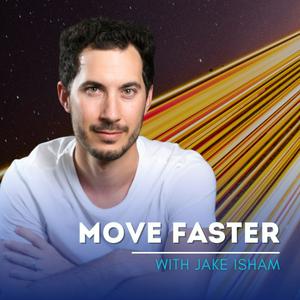
O Move Faster w/ Jake Isham
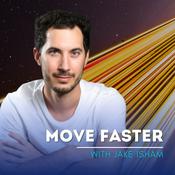
What does it actually take to build a career as a creative? Move Faster with Jake Isham is a solo podcast for artists of all kinds — filmmakers, photographers, musicians, actors, and beyond — who are serious about turning their craft into a sustainable career. Hosted by award-winning filmmaker, published photographer, and creative agency founder Jake Isham — whose work has generated over 1 billion views online — each episode openly shares the real lessons from his ongoing journey as a working creative, as he figures it out in real time. From mindset to marketing, productivity to business strat
Strona internetowa podcastuSłuchaj Move Faster w/ Jake Isham, Chłopaki od blurbów i wielu innych podcastów z całego świata dzięki aplikacji radio.pl
Uzyskaj bezpłatną aplikację radio.pl
- Stacje i podcasty do zakładek
- Strumieniuj przez Wi-Fi lub Bluetooth
- Obsługuje Carplay & Android Auto
- Jeszcze więcej funkcjonalności
Uzyskaj bezpłatną aplikację radio.pl
- Stacje i podcasty do zakładek
- Strumieniuj przez Wi-Fi lub Bluetooth
- Obsługuje Carplay & Android Auto
- Jeszcze więcej funkcjonalności

Move Faster w/ Jake Isham
Zeskanuj kod,
pobierz aplikację,
zacznij słuchać.
pobierz aplikację,
zacznij słuchać.
Move Faster w/ Jake Isham: Podcasty w grupie
 Polska
